It started the way it often does — with a routine mammogram.
In January 2025, Kathleen walked into The Ruth Beer Breast Center at ImageCare for her annual screening, expecting nothing more than a quick appointment and peace of mind. Instead, she got a call back. An ultrasound. Then a biopsy.
When the results came back positive, the word cancer landed hard.
“I almost died,” she said later, remembering the moment. “But my doctor just looked at me and said, We’ve got this.” That calm confidence built trust and reassured Kathleen, helping her feel supported throughout her journey.
From Diagnosis to Direction — All in One Place
Kathleen’s care began at The Breast Center, where imaging, biopsy, and follow-up were coordinated seamlessly through shared records. The same team that found the cancer helped explain what came next — no handoffs, no confusion, no waiting for answers.
When it was time to decide on surgery, Kathleen met with Community Care Breast Surgery. Together with her surgeon, Dr. Kelly Dennin, she talked through her options and chose a lumpectomy as her first step.
“Don’t worry,” her surgeon told her. “You’re going to be okay.”
That reassurance wasn’t just comforting — it was backed by a coordinated plan.
Surgery, Recovery, and a Curveball
In early April, Kathleen had her lumpectomy. It was an outpatient procedure, and she was able to go home the same day, with her daughter by her side.
But cancer doesn’t always read the script. When pathology revealed that another small area needed removal, a second surgery was promptly scheduled, and the care team adjusted the plan seamlessly to accommodate the unexpected development.
“It was frustrating,” Kathleen admitted. “But I trusted them. They explained everything, and I knew why we were doing it.”
The results brought relief: lymph nodes were clear, and the cancer was caught early, Stage I.
Chemotherapy with Support Built In
Next came chemotherapy at Upstate Hematology Oncology. Kathleen met with her oncologist, Dr. Rana Jacob, reviewed her treatment plan, and knew exactly what to expect, including the tough parts. “You’re going to lose your hair,” Dr. Jacob told her plainly. “And this is how it’s going to work.” No sugarcoating. Just honesty. Exactly what Kathleen was looking for in her care team.
Her chemo followed a structured rhythm — lab work, treatment, monitoring — week after week. Through it all, her care team tracked her labs closely and adjusted as needed.
And she wasn’t alone. On treatment days, her son flew up from Florida to be with her. When transportation was needed, community resources like the American Cancer Society stepped in to help. The goal was simple: remove barriers so Kathleen could focus on healing.
Radiation Therapy, Precisely Guided
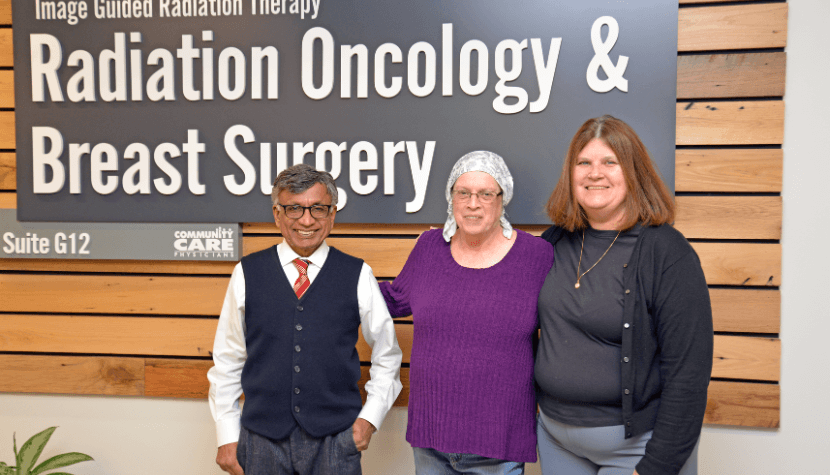
After chemotherapy, Kathleen moved on to radiation at Image Guided Radiation Therapy (IGRT). Before treatments began, she sat down with Dr. Arun Puranik in the conference room to review everything. She completed 21 treatments — each one carefully planned, clearly explained, and precisely delivered. “They were straight to the point,” Kathleen said. “This is what’s going to happen. And then it happened.” No surprises. No gaps in communication. Just care that kept moving forward.
One Roof Makes a Difference
Looking back, Kathleen is clear about what mattered most. “I preferred everything being under one organization,” she said. “Everyone already knew what was going on. I didn’t have to explain my story over and over again.”
From imaging to surgery, from chemotherapy to radiation, her care teams worked together — sharing information, aligning decisions, and keeping Kathleen at the center of every step. That coordination didn’t just save time. It reduced stress at a moment when stress was already high.
Life After Treatment
Today, Kathleen has completed surgery, chemotherapy, and radiation. She continues follow-up care and takes a daily hormone therapy as part of her long-term plan. And she’s doing well. “This year was something every single month,” she said. “But I made it.”
Her message to anyone newly diagnosed? “Try to stay positive. You’ll have bad days — that’s normal. But keep moving forward. Accept the support. Just do what you need to do.”
At Community Care Physicians, that’s exactly what we aim to provide — coordinated cancer care that supports the whole person, from the first screening to survivorship. Because no one should have to navigate cancer alone.
She concludes, “If I had to go through this again, I wouldn’t want my doctors to change. The care, the coordination, and the people made all the difference.”